
Introduction
A first-generation student expanding the world for her four children, Amanda Sanchez maintained a 4.0 GPA while fully embracing the Truist Honors Program’s countless opportunities. From winning the Society for American Archaeology Ethics Bowl as the first community college team in its 20-year history, to presenting research at five national conferences and studying abroad in the Azores, she navigates new communities in the world of Indigenous advocacy and legislation, archaeology and anthropology with the spirit and standards she grew to expect during her time at Central Piedmont. Experiences in the Honors Program have opened her eyes to systemic injustices she intends to heal with collaboration and reciprocity.
At a Glance
- Major: Anthropology & Indigenous Studies
- Focus: Archaeology, NAGPRA & Cultural Repatriation
- Program: Central Piedmont Truist Honors Scholar (2024–2026)
- GPA: 4.0, President's List, 5 Semesters
- Key Achievement: Society for American Archaeology Ethics Bowl Champion 2025
- Research: North Carolina Honors Association, National Association of African American Studies and Affiliates, Southern Sociological Society, National Collegiate Honors Council, American Anthropological Association
- Certifications: HarvardX Rhetoric, Responsible AI, CompTIA A+
- Memberships: Register of Professional Archaeologists, Archaeological Institute of America, Society for Applied Anthropology, Society for American Archaeology, Phi Theta Kappa Honor Society, Southeastern NAGPRA Community of Practice, National Collegiate Honors Council
- Transfer Goal: 4-year university for Archaeology BA
- Applying To: 39 universities
Foundation Reflections
Matthew Whitaker Quintet Concert
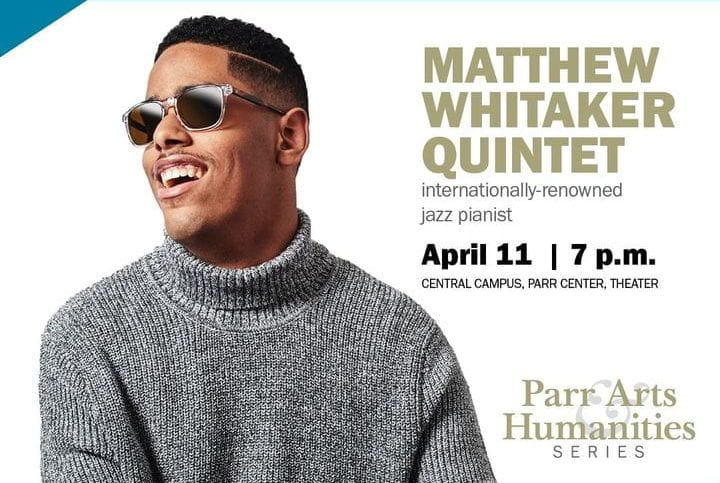
Energy pulsed through the Parr Center as Matthew Whitaker performed his hits and new songs from an upcoming album. I attended this concert because it was the first invitation I received since becoming a Truist Honors Scholar. I had the opportunity to meet some peers and Dr. Pritchett before orientation into the Honors Program.
Matthew Whitaker, a Juilliard graduate with an impressive musical background, was named the youngest Yamaha Artist at age 15. He was an incredible pianist. I am thrilled that I went to his concert because I enjoy jazz but never considered myself a true fan of it. Matthew Whitaker brought so much joy and enthusiasm to Central Piedmont that I could not help but clap and dance along. His energy was beyond any other musician I have seen before. The most exciting part of his performance was how he blended pop, R&B, and jazz seamlessly. I especially enjoyed his rendition of Earth, Wind, and Fire's "September."
I am taking away the experience of feeling unity and joy while enjoying a jazz virtuoso in the Parr Center. I am a new student at Central Piedmont, so embracing the wonderful things our community provides creates a sense of pride in my new academic institution that I hope only grows from here. I am thankful to have jumped into the Honors Program with this first thrilling experience.
Association of Latino Professionals For America / Bank of America L.I.F.T. Program Fellow
I learned about the Association of Latino Professionals For America L.I.F.T. Summer Program through the Truist Honors Program. As an older non-traditional student, I have long awaited the opportunity to pursue my education and made a personal commitment to fully embrace this experience and seize every reasonable opportunity that came my way. I applied immediately, recognizing it as a valuable opportunity, though I could not have anticipated just how transformative and comprehensive the program would be.
Initially, I did not view myself as a leader, largely due to a misunderstanding of what true leadership entails. However, throughout the insightful 8-week program, I acquired skills that would typically take years of professional experience to develop. The curriculum was holistic, covering essential topics such as personal branding, resume building, business etiquette, interview techniques, and industry-standard software tools including Alteryx, Tableau, Power Query, and SQL. My favorite sessions of the summer were the "Emotional Intelligence and Self-awareness" workshops. Gaining an understanding of myself and how to communicate effectively with different personality types is one of the most important aspects of leadership and will undoubtedly assist me in college and into my career.
What surprised me the most was the camaraderie and support among participants. I had expected a competitive environment, but instead, I found a community where everyone was eager to uplift one another. This collaborative spirit has reinforced my belief in the power of networking and mentorship. The most significant growth occurred in my self-confidence and my ability to articulate my ideas and ambitions effectively, a newfound confidence that now allows me to engage more actively in my academic pursuits and advocate for myself and others.
Stress Management for Honors Students
Central Piedmont Counseling Services joined us for a session to discuss ways to manage stress while being a student. I joined this session because I enjoy taking every opportunity that I am offered, and while I enjoy the work, I can feel overwhelmed at times.
During this session, we discussed ways to keep stress at healthy levels. First, we learned what symptoms may indicate that we are not managing stress well, headaches, sleeping or eating too little or too much, and overly emotional responses are some indications that stress may be at an unhealthy level. Some ways to keep stress low are to take breaks while studying, exercise, get outside for at least a few minutes each day, and practice self-care. I was surprised to learn that counseling services at Central Piedmont are free to students. I am proud to be a part of the Central Piedmont community because of the care placed on mental health.
I enjoyed this session because I was able to hear my peers' experiences with stress and learn that I am far from alone. I became aware that although I thought I was managing stress the best I could, there was more that I could be doing. I plan to go outside and take walks regularly. When my stress is lower, I am more productive. This conversation will help me in my academic and professional journey.
North Carolina Honors Association Annual Conference
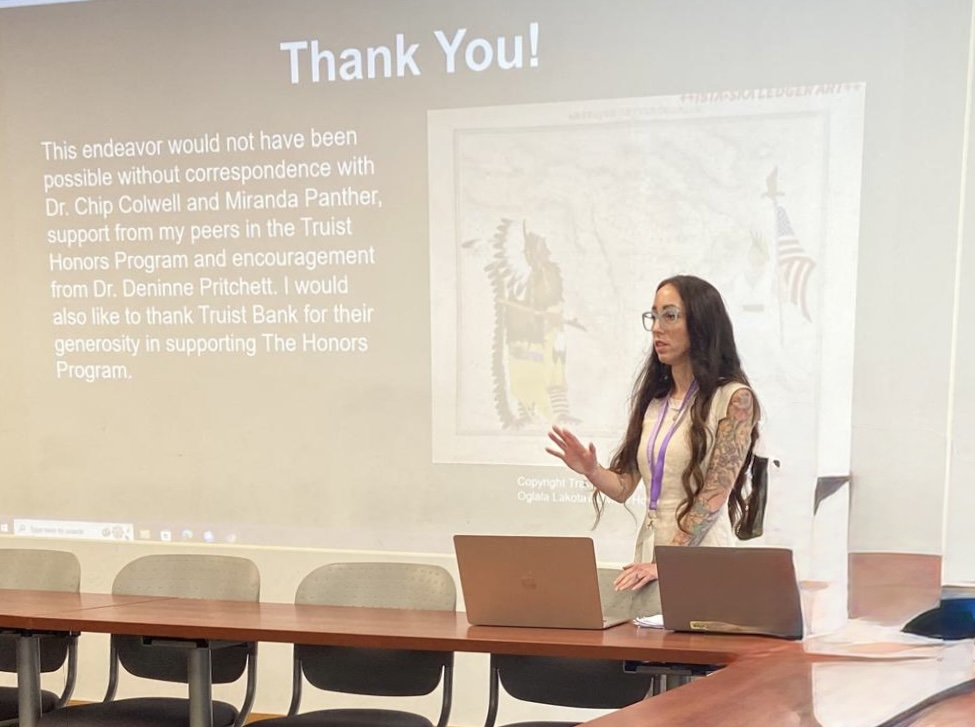
I presented research at the North Carolina Honors Association Conference at Western Carolina University. I participated in this research opportunity because I find it thrilling to uncover information. I have been curious about Native American cultures since I was a child listening to my grandmother's life stories. This research project presented the opportunity to explore ideas on how to regain knowledge that has been lost to time, removal, adoption, and violence. I ultimately decided to research the Native American Graves Protection and Repatriation Act (NAGPRA) because so much knowledge has been abandoned and forgotten in museum storerooms.
Presenting research at the North Carolina Honors Association led to growth in many areas. First, I had to learn how to conduct formal research, which will serve me later in life. I learned how to tune out anxiety and grew into a confident public speaker. This was a major achievement that took months of practice, listening to feedback and encouragement from my peers, and giving myself grace when I experienced setbacks. I found the beauty in commanding attention to a topic I am passionate about. Now, I speak up when I see something wrong when I would have stayed silent in the past. I have found my voice.
Since presenting my research, I have found a mentor in the NAGPRA field and have been invited into three committees of NAGPRA professionals. Having the opportunity to present research has set me years ahead in my future career. Without the Truist Honors Program, it would not have been possible to open so many doors toward my future.
Cultivating Your Cultural Attributes as a Leader
Dr. Jaramillo graciously led a discussion about using cultural attributes rather than suppressing them to advance in careers. Through sharing personal stories, Dr. Jaramillo stated that culture can be a barrier, but more often, cultural attributes have a clear advantage in the workforce. Values, work ethic, close families, and growth mindsets can be valued in many cultures. However, due to a disadvantaged background, cultures may experience institutional distrust, poverty, hurdles to being promoted, burnout, and imposter syndrome.
In my own family, getting married and joining the military at a young age has been the status quo. I have started college as a first-generation college student as an older, non-traditional student. I have been told I was not smart or worthy enough to earn a degree and that I would always need to depend on a man; this held me back for years. Dr. Jaramillo acknowledged that imposter syndrome is a common experience, and her candor helped me see my peers and my own journey differently. She also connected burnout and minority work culture in ways that helped me understand patterns in my own family that I had never named before, including my father, who worked through a year of chemotherapy without taking a single sick day. I had always assumed he was humble or shy. I never considered it to be related to his culture.
Dr. Jaramillo suggested that rather than cultural attributes holding minorities back, they should be used to propel them forward. I come from a long line of ancestors who have fought injustice and suffered for it. Their values are deeply ingrained in my DNA. I hope one day I will be in a position of leadership where I can not only hold doors open but also construct buildings for those who come after me.
Study Abroad, Azores, Portugal
My 2024 fall break was filled with the excitement of ocean water splashing all over me while learning about ocean diversity, the knowledge of farming from historical to modern times, direct interaction with a new culture, seeing sustainability in action, relaxation in nature, sweet and savory flavors, and the development of new lifelong friendships. My adventure to the Azores was exhilarating and insightful. It changed my worldview completely.
We visited a family farm, Quinta do Agricultor, that is passionately sentimental about preserving knowledge of historical Azorean farms. The house had no electricity, so we immersed ourselves in 1800s farm life. The meal was incredible, I could taste the love poured into every dish. Later in the week, we visited a family home in a small village where Maria gave us a tour of her backyard garden and taught us to use the ingredients in a cooking class. In both of these welcoming experiences, Azorean hospitality was perfectly represented. Through years of struggle and self-sufficiency, Azoreans have learned that community is essential to survival.
The most surprising aspect of my time in the Azores was how resilient, kind, and hospitable the Azorean people were. When faced with adversity, they always find hope and a way to move forward even better and more efficiently than before. I will keep the spirit of the Azores with me as I move through academic environments and in my career path. The knowledge of sustainability, adaptability, triumph through adversity, and kindness is one I hope to radiate from within. Failures are the beginning of new growth, as I have witnessed firsthand.
Cherokee Archaeology Symposium, Eastern Band of Cherokee Indians
The 11th annual Cherokee Archaeological Symposium was held by the Eastern Band of Cherokee Indians on the Qualla Boundary, where leaders in archaeology, representatives from federal agencies, and professors came to present relevant findings to Southeastern Indigenous Communities. The Symposium was designed to build relationships between the Tribe and industry professionals to foster better working relationships. Undeniably, they achieved this goal, it felt more like a family reunion than a symposium.
I was invited by one of the Eastern Band of Cherokee Indians' Tribal Historic Preservation Office officers, Miranda Panther, after I presented research on NAGPRA at the North Carolina Honors Association Annual Conference. She recognized my passion and was impressed by the Truist Honors Scholars and graciously extended the invitation to all of us. One of my favorite presentations was Scott Ashcraft's "Ancestral Cherokee Landscapes and the Failures of a Profession", he described how it took him twenty years to convince others that archaeological findings on sloping landscapes were significant. I also enjoyed an update on the Trail of Tears Remediation by Melissa Twardowski from the USDA Forest Service, and a presentation by Kaley Kelly, who displayed considerable cultural sensitivity by calling each location by its Cherokee name throughout.
Observing the researchers' relationship with the Eastern Band of Cherokee Indians was especially moving. They came to the Symposium seeking to learn from the Tribe and asking permission to conduct research, none of their work was conducted without the Tribe's approval. Each archaeologist exhibited qualities that profoundly shaped my view of how Indigenous research should be correctly presented. Being a Truist Honors Scholar has opened doors not usually accessible to a community college student.
Social Courage in the Workplace
I joined this meeting because I am working on using my voice effectively in social and academic situations. I have not always felt comfortable speaking up about difficult social situations, especially when it may affect my scholarly reputation. Dr. Morman-Lyerly spoke authentically about her experiences as a leader, sharing times when she demonstrated social courage and how the results were not always as expected. She was easy to speak with and related to us by acknowledging she had faced many of the same situations we had concerns about.
The importance Dr. Morman-Lyerly placed on courage in professional settings was incredibly insightful. Everything you have worked hard and sacrificed for is on the line if you speak up in the wrong way or to the wrong person. She said to take five minutes and think about what is going on, why it is happening, who is involved, and assess what the best course of action is. She also gave examples to pull the person aside and have a reasonable conversation with them first, depending on the situation, before going up the chain of command.
When you decide to speak out, it is not always popular. You will lose friends, and witnesses may not be willing to admit they saw anything. Dr. Morman-Lyerly directly told us to expect this. However, she encouraged us to reflect on our decision to speak out, and if we feel we acted appropriately, be confident in it even if we stand alone. Ostracization from peers does not always mean you have made the wrong decision. Social courage in the workplace was one of the best meetings I have attended in the Truist Honors Program, and that is quite the compliment.
Overcoming Research Anxiety
As a new researcher with only one presentation completed so far, I have a lot to learn about the process of researching. I am starting a new project that I will not be able to find resources for online easily. I joined this session in hopes of learning how to identify who is the best source to interview when there are no written sources currently available.
Dr. Pritchett walked us through the research process from observation to problem identification, surveying, and gathering data, both quantitative (numbers) and qualitative (description and lived experiences through firsthand interviews). I learned that a "void", a topic not yet written about, or a topic with too much conflicting information both indicate an area that needs careful investigation. Dead ends in searching often mean you are not yet using the most precise related terms, and that specificity matters enormously. She also explained the concept of positionality: studying something you are a part of, while taking clear steps to reduce bias in your questioning and reporting.
The session ended with critical-thinking exercises that reminded me how often we overlook ordinary words or are misdirected by irrelevant information. The lesson: "What am I missing?" is the most important question a researcher can ask. This session gave me a framework to approach my upcoming NAGPRA research with more discipline and less anxiety. I now understand that research is a skill built incrementally, the same way you would train for a marathon.
Building Relationships & Psychological Contracts
Dr. Warren works in organizational leadership and development, helping people succeed both interpersonally and intrapersonally. His session introduced the concept of psychological contracts, the unspoken agreements between two or more people, and how understanding yourself and the people around you is foundational to any leadership role. He emphasized listening not to respond, but to understand; developing emotional intelligence; and learning to laugh at yourself, because "you're not that interesting", meaning, not everything is serious or about you. De-weaponizing social experiences by not taking every slight personally is a skill worth cultivating.
He spoke to leadership versus fellowship, noting that not everyone is a follower, and that being able to follow a great leader can be its own path to success. His reminder that "if you don't have followers, you're just out taking a walk" grounded the session in practicality. He also addressed motivation directly: it only comes from doing what you need to do to get to the end results. Energy in motion is the act of doing something, and once you get started, the energy and motivation build from there.
Dr. Warren quoted Dr. Martin Luther King Jr.: "Faith is taking the first step without seeing the stairway." I left this session with a clearer understanding of how to adjust my actions based on self-knowledge, how to hold myself to a standard so that nothing negative sticks, and how to lead by example in every academic and professional environment I enter.
Honors American History II Course Reflection
I was so excited to take one of my first college-level history courses. Having it be an Honors course was a bonus. I expected to learn as much about Presidents as I did while reading their biographies and personal journals, which was quite silly and a little ambitious of me. While initially disappointed with the lack of detail, I soon realized the benefit of learning little elements on a wide range of topics. I hold political biases, and this course challenged them. I thought of myself as a history nerd, but was I truly if I wasn't more curious about the motivations of politicians I didn't care for?
Learning Journals were my least favorite because they offer a limited set of sources; however, they pushed me to pay attention to areas I wasn't as interested in. Without adherence to sources from each module, I would have focused solely on what I enjoyed, furthering my bias. As someone with ADHD, it can be hard to pay attention to areas I have little interest in. The instruction to focus on certain topics made me pay attention and absorb material that I was uninterested in. In doing so, I found value and interest in the subjects. I connected events and people I thought I didn't care for to those I do care for.
During the first weeks, I complained about how much unions are represented in American History II. As this course continued, I realized how intrinsic unions are to our political and economic systems. I formed connections to civil rights, which I cared deeply for, and unions. My confusion about unions transformed into curiosity. My areas of interest have expanded, and I am certain collecting used books as souvenirs on vacation will be even more enjoyable now. The only downside is I will need to buy a larger suitcase.
Society for American Archaeology Ethics Bowl, First Place
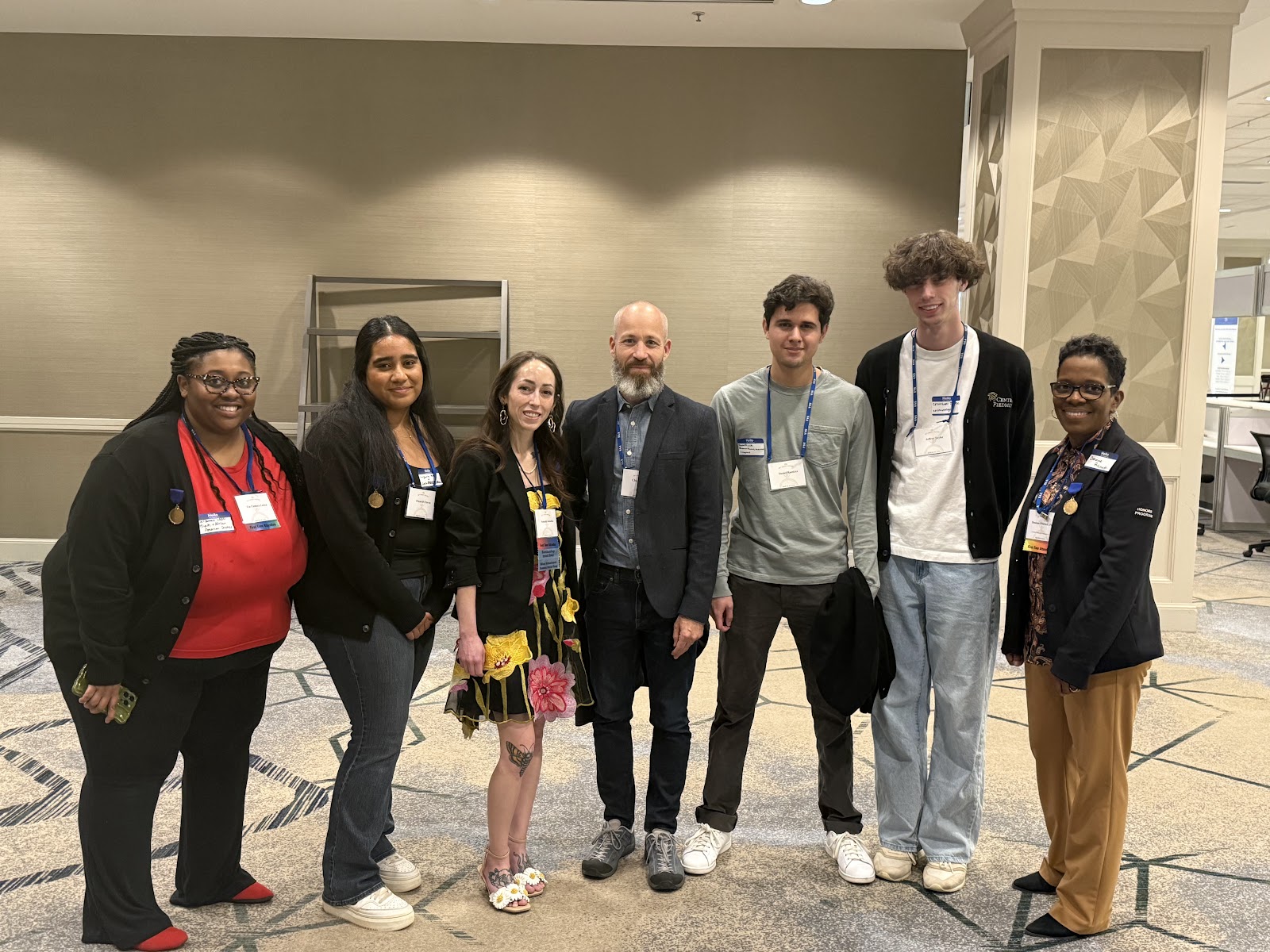
Perhaps the most exciting event of my life, the Society for American Archaeology Ethics Bowl 2025. Archaeology historically has been exclusionary of non-traditional students, and most Native Americans see it as bad medicine. This comes from extraction and practices that exclude the communities archaeologists typically study, such as the Black and Brown, Indigenous communities, and lower income areas as well. It comes as no surprise that in the Ethics Bowl’s 20-year history a community college has never participated.
That changed once the Honors Program supported me to begin researching, and my question was how to return spiritual practices and oral history to Native American communities that Manifest Destiny attitudes continue to push into extinction. Ultimately, I focused on repatriation legislation, like the Native American Graves Protection and Repatriation Act. At my first research presentation in October 2024, I met someone whose work influenced my research. Miranda Panther came to the conference and became a mentor and friend. Shortly after, she invited me to the Eastern Band of Cherokee Indians Archaeology Symposium. I went to spend time learning from Miranda, and left understanding that Native Americans were making a seat at the table for themselves in archaeology, controversial in their communities, most have been called “Grave Robber” several times. They persist through barriers within the field and their communities because the work is deeply personal, and meaningful to them.
After learning how to spell “archaeology” I needed to know more about this field I had never considered I could participate in before. Soon, I encountered a flyer for the Society for American Archaeology Ethics Bowl and, knowing it was not in the cards, suggested that the Truist Honors Program should form a team. Dr. Pritchett told me to organize one and she would take care of the rest. I organized a gargantuan OneNote Notebook, dropping everything I could learn about archaeology ethics into it. Dr. Pritchett finally introduced me to Dr. Bowers, and he helped me focus clearly on ethical issues, while providing resources the internet could not. My teammates were patient, kind, and willing to meet late into the night twice weekly for a couple months leading up to the Ethics Bowl.
They had little interest in archaeology but maintained a sturdy moral compass. Being from communities that archaeological ethics, and truly ethics in general impact the deepest, they were familiar with right and wrong from experiencing all too often wrong ethical decisions impacting our communities. We were selected to participate, and flew to Denver, aware of our underdog status. I thought we had one glorious round of three, at most, in the bag. What I was not expecting was to win, by a landslide. Textbooks are great, but lived experience teaches more impactful lessons.
Injustice ignites something in me, and now I am proud to say I am assisting and learning from the Ethics Bowl Committee, who will step down next year, and I will step into a leadership role for the 2027 Ethics Bowl Committee. The Truist Honors Program showed an entire field that community college students belong in archaeology, despite an incredible lack of resources and funding. This experience sparked a journey to make archaeology better by meeting students where they are: at community colleges, HBCUs and Tribal Colleges, and on social media.
That infamous OneNote? It is now in production as a tool for all students to participate online in Ethics Bowl games to study ethical codes, participate in preliminary rounds, connect low income students to cross-university teams with resources, and connect mentors to students who lack a fearless founding director, a Zen professor, and an incredible program like the Truist Honors Program. When Dr. Pritchett says, “If Scholars can dream it, the Honors Program can do it... unless a policy states otherwise” she means it.
Not only can I spell archaeology now, I am a declared archaeology major who has been accepted into a global top five archaeology program for Fall 2026 transfer, anticipating more acceptance letters in May before I commit.
Central Piedmont Ethics Bowl Article | Register of Professional Archaeologists Announcement
National Association of African American Studies and Affiliates: 33rd Annual National Conference
Presenting "Returning Dignity: Reforming Repatriation Legislation for Tribal Empowerment" at the National Association of African American Studies and Affiliates conference in Dallas was my second research presentation, and the first time I presented to an audience outside of the honors community. The conference brought together scholars from African American studies, Native American studies, sociology, and history, and I was nervous about presenting archaeological research to people who approach cultural heritage from completely different disciplines. What I found was that the parallels between Indigenous repatriation and African American burial ground preservation are powerful and deeply personal to the scholars in that room. Conversations after my presentation lasted longer than the presentation itself, and I left Dallas with connections to researchers I still email today. The Truist Honors Program prepared me to step into unfamiliar academic spaces with confidence. This experience taught me that repatriation is not an archaeology issue; it is a human rights issue that resonates across every community that has had its heritage stolen.
Major Disasters and Social Responses: Webinar Intro Speaker
Introducing Carson Doyle for the Truist Honors Program webinar on Major Disasters and Social Responses was my first experience as a speaker host rather than a presenter. As a Federal Work-Study student in the Honors Department, I had the opportunity to prepare the introduction, set the tone for the session, and manage the flow of the conversation. Carson discussed how communities have responded to natural disasters across centuries, from Hurricane Katrina to the recent flooding in Appalachia and across the Southeast. The themes of community resilience and how disasters disproportionately affect vulnerable populations connected directly to my research on Indigenous communities and cultural preservation. Preparing to introduce someone else taught me a different kind of public speaking: the kind where your job is to make someone else shine. The Truist Honors Program gives scholars leadership opportunities that extend beyond presenting our own work, and this experience showed me that facilitating space for others to share their expertise is just as important as being the expert in the room.
Walt Disney World Imagination Campus
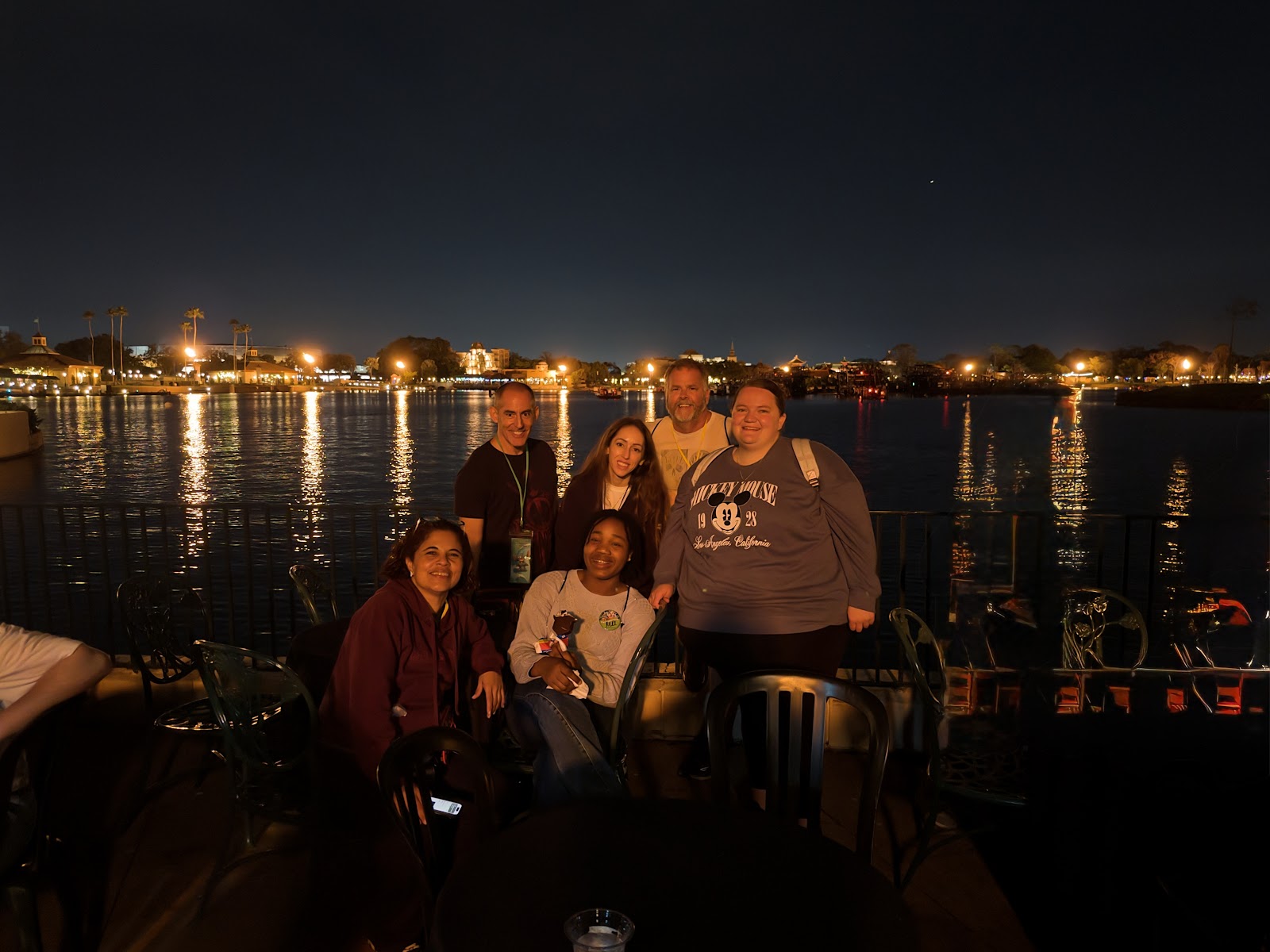
The Walt Disney World Imagination Campus experience was filled with a surprising amount of educational, professional, and personal life lessons. Over five days at Disney, I participated in workshops on leadership, innovation, arts and humanities, and what struck me most was how quickly a group becomes a team in the right conditions. Scholars who are typically shy shined as leaders, while outgoing students like me learned how to work in teams effectively. As a mother of four, I have been to Disney countless times. This experience showed me the immense attention to detail, from sensory to care for employees that has deepened my appreciation for the brand, and my time with my children in the parks. The Truist Honors Program made this trip possible, and it reinforced how team culture is to be carefully curated.
I returned to Charlotte with insights into areas I can improve as a team member and leader, while at times being both simultaneously. I will carry these lessons into my future academic career and professional environment. The best teams are comprised of team members who all lead in different ways. Practicing lessons I have taken from the Walt Disney World Imagination Campus Workshops within my home, from sensory details to teamwork, has already greatly improved my life. Each student should have opportunities like these, and society would greatly improve. I see myself advocating, donating, and cheering on students to attend these special workshops once I am established in my career.
Common Read Student Leader and Alejandra Campoverdi: “First and Only”
Bringing Alejandra Campoverdi to Central Piedmont was the culmination of seven months of work as the Common Read Student Leader for “First and Only.” Working alongside Instructor Pollard-Smith, I took outside courses on journalism to interview great Central Piedmont “First and Onlys” including Instructor Megumi Naganoma who shared her deepest wounds, how she overcame them and discussed these trials with us. Needless to say, the interview was hours long, as we were all captivated, and knew the weight of her words. Our next guest, Dr. Strickland-Davis, was equally captivating, and as vulnerable during our chat, sharing life lessons, and the trauma that sometimes comes from forging a First path.
Learning we would host the author of our book, First Gen: A Memoir by Alejandra Campoverdi was almost overwhelming in the best way! Standing on stage in Tate Hall next to Alejandra to my fellow scholars was empowering; she is truly a human just like us, a fantastic one at that. Her words filled all of us in the audience with pride as a “First and Only” no matter the First we were overcoming. As a first-generation student, Campoverdi’s message about being the “first and only” and the guilt that inevitably comes with walking in two worlds validated personal experiences. The book and subsequent conversations helped me understand that my heart was actually being pulled in two directions, one on a farm with my grandmother who still lives like it’s 1928 and the ivory towers I am pursuing.
The biggest lesson I took away was how tied to the community I feel when speaking with the greats at Central Piedmont, the fearless and fashionable leaders who seem out of reach; furthest assumption from the truth; they are invested in students, and speaking with them almost as an equal gave me comfort knowing how deep my roots are in Charlotte. The Truist Honors Program trusted me with this leadership role, and it taught me how to spark deep conversations that help us get to know one another. This experience confirmed that storytelling is a conversation that can spark a powerful community culture.
Southern Sociological Society 88th Annual Conference
Presenting my research at the Southern Sociological Society conference in Charlotte was very insightful seeing how closely related anthropology and sociology truly are. My presentation focused on Indigenous repatriation legislation reform by understanding the activism that prompted the legislation to begin with. Running Moccasins, known as Maria Pearson, learned of grave site destruction and looting of an Indigenous woman and small child, while the Caucasian ancestors were reburied. She waited outside her governor’s office until the issue was properly addressed, resulting in the first legislative act in the United States that specifically protected Native American burial sites and remains enacted in 1976, the Iowa Burials Protection Act. Her story shows that one person can make a large difference, with enough passion.
Presenting in Charlotte, our home, was a gift; the audience was packed with most of my favorite instructors, with one even rushing to see my presentation between classes! The Southern Sociological Society conference brought together scholars from sociology, criminology, and related disciplines, and presenting anthropological research blended in well. With the audience full of familiar faces, finding a community outside of anthropology and archaeology, the Southern Sociological Society built my confidence to greater heights. This was my third research presentation through the Truist Honors Program, and each one has built on the last, from the nerves at the North Carolina Honors Association to the confidence I felt in Charlotte. It sealed my fate as a presenter, public speaker and research nerd. I am grateful for such a life-altering gift from my community, and the sociological community.
National Collegiate Honors Council 60th Annual Conference
Presenting “Institutional Responsibility: Ethical Practices for Intergenerational Healing” at the National Collegiate Honors Council conference in San Diego was exciting. This was a national stage filled with bright honors students and faculty from across the country, and I was presenting on communal spiritual health and healing through reciprocity, my passion! The audience was intrigued, resulting in the longest Q&A session of mine so far, which was actually more of a conversation. What struck me most was how many people are deeply invested in repatriation once they learn what it is and how it became a necessity.
The National Collegiate Honors Council conference brought conversations with faculty from other Honors Programs around the country. A surprise to no one at all is that the Truist Honors Program is an example of a perfect program, and the nation is watching. To say I swelled with pride is an understatement. I knew how lucky I am to be a Truist Honors Scholar, but seeing more experienced programs ask for our secrets to success was confirmation that the best Honors Program in the country is in Charlotte, North Carolina at a community college. The secret? Passion! Our director is passionate beyond her titles and works tirelessly every single day to make her students great, which has the fortunate side effect of creating the best program and community.
As a community college student presenting alongside students from four-year universities, I felt a sense of belonging. The Truist Honors Program prepared me for this moment through practice sessions, public speaking courses, webinars on PowerPoint, Canva, and courage. This presentation solidified that no matter where I land after Central Piedmont, I need to be in the honors community to stay among the best young minds in the nation. This time spent with fellow Truist Honors Scholars brought us close, and seeing their joy at the Keynote speaker, The Space Gal herself, Emily Calandrelli, was a top moment of my entire life. The best part of this experience was seeing my peers’ presentations, and feeling their passion burn as bright as the San Diego sunshine.
Gratitude Celebration
The 2025–2026 Gratitude Celebration was delightful. This event brought together scholarship recipients and the donors who fund programs like the Truist Honors Program and allowed space for us to share our experience with donors. I hold a great amount of gratitude for how fundamentally transformed I am in under two years as a Truist Honors Scholar. What made this experience meaningful was connecting with peers from other cohorts, and networking with donors. As someone whose entire honors journey has been made possible through Truist Foundation funding, this was the event for me to brag about my experience.
Seeing the faces behind the funding made it more tangible that one day, should I be lucky enough, I will be in their shoes. Programs, especially at the community college level, are something I am an advocate for. Watching the Truist Honors Program grow, my peers achieve their dreams earlier than any anticipated and knowing how every cell inside me has changed to a better, brighter version fuels a duty to give back. I left the celebration more committed than ever to philanthropy for students who are sometimes overlooked and underestimated. I understand that Truist is not signing a check; they are fueling future leaders and transforming our city into a better version of itself with educated, confident, well-traveled, socially responsible citizens.
Grit & Resilience Workshop
The Grit and Resilience workshop arrived at a time of change and transformation, where I was doing amazing things, things I believed I was incapable of a few months earlier. Ms. Nnaji was a calming presence and helped me calm the tornado of open tabs in my brain. The concept of grit resonated with me because it described more perfectly what I had always called “work ethic.” It is deeper than that; it is a combination of work ethic, determination and responsibility to ensure you are mentally and physically strong enough to pursue your passions. Reframing it in my mind gave me permission to check in with myself, take breaks, and drink water.
Most importantly, she discussed being outside in nature, something that has always centered me but that I had left behind in my marathon of becoming the student, friend and teammate I never knew I could be. The Truist Honors Program consistently provides professional development opportunities that address growth beyond academics. This session calmed my chaos and helped me give myself permission to play outside sometimes. From experience, it has improved my studies, research, and overall happiness, as well as the health of my family.
Echolocation Technology: Shane Seheult, McMaster Bat Lab
The Echolocation Technology session related to archaeology in surprising ways. For example, echolocation, and the technology created from researching it has been a driving force in tools archaeologists use, even the most fascinating advancement in recent decades, LIDAR, was partially influenced by bats. I had never thought about how common it is to borrow “technology” from the natural world. As someone focused on archaeology, I immediately connected this to how echolocation and sonar technology relates to archaeological fieldwork and the important non-invasive detection methods used to protect cultural and sacred sites, preventing future repatriation processes, and their accompanying trauma.
The Truist Honors Program opens worlds and technologies beyond our majors, and this session showed how biology actually plays more of a role in each major. I left thinking about other animal abilities that should be studied to further the archaeological record without site destruction.
Canva Design Workshop
Taught by a fellow scholar, and master of all, Faith Blom, the Canva Design Workshop taught me how to use Canva and inspired me to immediately begin creating and playing with the software after the webinar was complete. As an official Death by PowerPoint hater, this session showed me a way to make my presentations look nicer without stress. I signed up for an account, and have used it from time to time, though I do mostly use Adobe because it is the subscription I already pay for. Surprisingly, they are remarkably similar tools! I translated what Faith taught us in Canva to learn new ways to use a tool I am already familiar and comfortable with. The Truist Honors Program supports research presentations all year long, not just before a conference by offering skills like these to implement in our visual presentations at conferences and in the classroom.
Honors Scholar Leadership Council
Serving on the Honors Scholar Leadership Council is my proudest achievement as a Truist Honors Scholar. The Council seeks to understand the needs of all honors scholars and helps shape experiences through collaboration. My role involved listening to scholars, meeting with other Leadership Council members, and exploring our leadership style through reading and practice. As someone who has suffered with low self-esteem, being selected for this role was a pivotal moment in my life that filled me with understanding that I belong. My mind cannot return to the framework of feeling as though I do not belong somewhere after this experience!
The Truist Honors Program gives us seats at tables where decisions are made, and once you have that kind of confidence, it stays with you. I learned to be selective about who I call a leader after gaining the understanding that “leader” is not a title; it is a commitment to yourself, and your community. Everyone is a leader in their own right, and after studying leadership I have come to understand my experiences with bad leaders, accept those poor situations, and be respectful while wary of those I trust to follow. I am more comfortable in professional environments and understand that I will work towards being a better leader for the rest of my life; an exciting discovery now that I have the tools to practice flexible leadership in a variety of situations.
Evolution of Mental Health: Courtney Aucoin, McMaster University
The Truist Honors Program invited Courtney Aucoin from McMaster University to present on the evolution of mental health, and this session renewed my perspective on how I understand depression. Aucoin introduced the concept of the Environment of Evolutionary Adaptedness, which occurred during the Pleistocene era, 2.6 million to 12,000 years ago. Our brains were built for the complexities of that period, not this one. Modern social stress, and pressure for relentless productivity, self-imposed in my case, create a mismatch that manifests as what medicine calls disorders. She shared a question that I am still considering: if depression affects up to 40% of the population in a lifetime, and most cases resolve through spontaneous remission without treatment, can it truly be called a dysfunction? She presented depression as an adaptation, which validated certain feelings I was currently experiencing. Sadness can be motivation for analytical rumination, a “distraction-resistant thinking” state that allows us to process complex social problems.
She explained the concept of anhedonia, and that it is not a blanket inability to feel pleasure. Instead, depressed individuals still find comfort in resting and thinking, which serves the rumination process. As a first-generation student managing the stress of four children, a 4.0 GPA, and applications to 39 universities, and even more scholarships, her webinar gave me language for what I have lived: the need for more downtime in a world that is not considering how our brains actually work. This session showed me the Honors Program shapes the whole person and gives us resources like this session to think critically about the human experience itself, which spurred deeper understanding in my own research on how communities process intergenerational grief and loss through repatriation.
Development of Big Brown Bats: McMaster Bat Lab
The Truist Honors Program hosted Shane Seheult and Tang Tang Guo, graduate researchers from McMaster University’s Bat Lab, to present on the development of big brown bats. I felt terrible balancing helping my children with homework while listening in, but what I did not expect was that my seven-year-old, doing homework beside me during the virtual session, would become as captivated as Dr. Pritchett and the rest of us. Shane presented his PhD research on auditory development, explaining that bat pups are born with their ear canals sealed shut and that, remarkably, their ears open asynchronously with the left ear typically opening before the right. Tang Tang Guo followed with her research on sibling rivalry and mother-pup interactions, examining parent-offspring conflict in big brown bat colonies.
Both presenters made complex biological research feel accessible. My 7-year-old was drawn in just as much as our program director, and that says something about how well they communicated. I struggle with translating my own NAGPRA research for audiences outside of archaeology, and watching these presenters do it so naturally gave me something to work toward. The Honors Program has offered so many researcher presentation webinars that I am constantly learning to communicate and research more effectively.
Community Service
Second Harvest Food Bank
The most pivotal experience at Disney was complete ego death at my favorite activity: the food bank. I tried so hard to understand their system and felt like it would be simple until I actually began the task. When we had a mandatory break, I did not want to take it. I wanted to be a better volunteer for this important mission, which was something I heard from several other peers. I have the privilege of a full cabinet at all times now, but that has not always been the case. Being there and giving back to a service I received at a point in my life was extremely emotional. I will be going back in Charlotte, in Florida, or wherever I go at least a few times a year. I did not know how much work went into it when I received family boxes, but now that I do, I know I need to help. Having fed over 7,000 individuals with all the stops to ask questions is impressive. I find volunteering at the food bank teaches creativity, communication, leadership, team building, and most of all, empathy and understanding for others in our communities.
Open House Volunteer
I volunteered at the Central Piedmont Open House because I remember walking through those same doors as a mother of four, unsure if I belonged in college at all. Now I was on the other side, answering questions and telling prospective students about the Truist Honors Program. One woman asked me how I manage school with kids and I told her the truth: it is hard, but the support here is real. I could see her shoulders relax. That small moment meant more to me than I expected. The Truist Honors Program made me the student I am, and I wanted families to know what is possible here.
Truist Honors Program Orientations Volunteer
I remember my own Truist Honors Program Orientation. I was overwhelmed and excited, unsure of what to expect. Volunteering at the Summer 2025 orientations put me on the other side of that experience. I answered questions, shared my honest experiences, and watched new scholars light up the same way I did. One student asked if the program was really as life-changing as the website says. I told her it was more. I have grown more in this program than in any other period of my life, and being part of welcoming the next group of scholars reminded me of that.
Cards for Atrium: Honors Convening
I was not expecting to feel so emotional making cards for patients at Atrium during the Honors Convening. My peers and I sat together, writing notes by hand for people we would never meet. It was quiet work, and the conversations that came up while we were crafting were some of the most honest I have had with my fellow scholars. I kept thinking about times my own family members were in the hospital and how a small gesture from a stranger would have meant the world. I am grateful to the Truist Honors Program for creating space for us to serve our community in ways that feel personal.
Senior Night Volunteer
Volunteering at Senior Night was bittersweet. Watching scholars celebrate their final semester at Central Piedmont while knowing my own time is ending brought emotions I was not prepared for. Setting up tables, greeting families, and cheering on peers who have become friends reminded me that the Truist Honors Program is more than a credential. It is a family. I volunteered at Senior Night during my first semester and now I am the senior being celebrated. I did not expect that to hit me as hard as it did.
Honors Courses
7 Honors Courses | 19 Honors Credits | GPA: 4.0 | All Grades: A
ACA-122: College Transfer Success
ACA-122 was the course that gave me a roadmap when I had no idea where I was going. As a non-traditional student returning to education after years away, I needed structure and direction. This course taught me how to research transfer institutions, build a timeline, and advocate for myself in academic advising meetings. I mapped out applications to 39 universities in this class, which seemed impossible at the time. The honors section pushed me to think critically about what I wanted from my education, not just where I wanted to go. I left this course with a plan and the confidence that I belonged in higher education.
COM-231: Public Speaking (Section N830H)
Public Speaking transformed how I communicate. Before this course, presenting research at a conference was unthinkable. My persuasive speech on Hurricane Helene response challenged me to argue a position with evidence and conviction, skills I now use at every conference podium. The honors section required a higher standard of preparation and delivery, and the feedback from my instructor and peers was direct and invaluable. This course laid the foundation for every research presentation I have given since, from the North Carolina Honors Association to the National Collegiate Honors Council. I learned that my nervousness before speaking is not something to fix. It is just energy, and I can use it.
HIS-132: American History II (Section N882H)
American History II with Instructor Kathryn Wells broadened my understanding of history beyond the textbook narratives I had accepted without question. I was particularly struck by the sections on union history, a topic I knew nothing about but found deeply connected to the labor and community advocacy I care about. The honors coursework pushed me to examine my own biases and learn how to identify political framing in primary sources. I began buying used history books after this class, a habit I never expected. Most importantly, this course showed me that history is not neutral, and understanding that has shaped how I approach my research on Indigenous repatriation.
ENG-112: Writing and Research in the Disciplines (Section N804H)
ENG-112 is where my research writing became serious. My comparative analysis on "Repatriation Reform: Decolonizing Ancestral Remains in the United States and the United Kingdom" was the first time I produced work that felt like it could stand alongside professional scholarship. Instructor Zeba Mehdi challenged me to write with precision and back every claim with evidence, habits that now define my conference presentations. The honors section required peer review at a level that simulated academic publishing, and the feedback sharpened my arguments. This paper became the foundation for every research presentation I have given, and I am proud that my research started here, at a community college.
HIS-131: American History I
American History I gave me the historical context I needed to understand the Indigenous communities I research. Learning about pre-colonial America, westward expansion, and the policies that systematically displaced Native peoples connected directly to my work on NAGPRA and cultural repatriation. The weekly honors discussion posts pushed me to engage with primary sources and defend my interpretations, building the critical thinking skills I use in every research paper and conference presentation. This course confirmed that my passion for Indigenous history is not separate from American history; it is central to it.
HUM-211: Humanities I
Humanities I taught me something I did not expect: how to work on a team. My group, including Aiden Ong and Drew Pringle, became collaborators I trusted completely, even during 3am study sessions before deadlines. The honors signature assignment on successful teamwork skills forced me to reflect on how I contribute to groups and where I fall short. I learned that leadership in a team is not about being the loudest voice; it is about listening, delegating, and showing up consistently. These lessons have directly influenced how I led the Common Read, organized the Ethics Bowl team, and collaborate with peers at conferences.
HUM-130: Myth in Human Culture
Myth in Human Culture challenged my assumptions about what counts as knowledge. Studying mythology across civilizations, I found parallels to the oral traditions and spiritual practices central to Indigenous communities I research. The honors coursework required me to examine my own cultural beliefs before and after the course, and I was surprised by how much my thinking shifted. Understanding how societies use myth to explain the world deepened my appreciation for why repatriation matters: when you take an ancestor or a sacred object, you are taking apart a story that holds a community together. That idea changed how I talk about repatriation. This course connected my humanities education directly to my archaeology work in ways I did not anticipate.
Transferable Skills
Cognitive Development
Advanced critical thinking and analytical reasoning through Ethics Bowl preparation, research methodology, and honors coursework. I approach complex problems by examining multiple perspectives and constructing evidence-based arguments, skills sharpened at five national research conferences.
Oral Communication
Strengthened through the Society for American Archaeology Ethics Bowl championship, presentations at the North Carolina Honors Association, National Association of African American Studies and Affiliates, Southern Sociological Society, National Collegiate Honors Council, and American Anthropological Association conferences, leading the Common Read, and completing the HarvardX Rhetoric and Toastmasters Public Speaking certifications. I articulate complex archaeological and ethical concepts to diverse audiences with clarity and confidence.
Written Communication
Refined through extensive honors research papers, a peer-quality comparative analysis on NAGPRA repatriation law (ENG-112), and the HarvardX Rhetoric certification. My writing balances academic rigor with accessibility, ensuring complex ideas about Indigenous rights reach broad audiences.
Self-Development
As a first-generation, non-traditional student and mother of four, I have cultivated resilience, time management, and a growth mindset. The Honors Program taught me that discomfort is where growth happens. I now seek challenges rather than avoid them, from study abroad in the Azores to competing at national championships.
Social Awareness & Connections
Deepened through global engagement in the Azores, the Cherokee Archaeology Symposium, and my focus on Indigenous rights and cultural repatriation. I actively build connections across cultures and advocate for communities whose voices have been historically marginalized, holding memberships in the Register of Professional Archaeologists, Archaeological Institute of America, Society for Applied Anthropology, Society for American Archaeology, Phi Theta Kappa Honor Society, Southeastern NAGPRA Community of Practice, and the National Collegiate Honors Council.
Technological Development
Expanded through CompTIA A+, Responsible AI, Adobe Creative Suite, web development, and digital research tools. I designed all Common Read promotional materials professionally and integrate technology ethically into my academic work, from GIS-adjacent research to building this ePortfolio. The Honors Program has made me confident that I can do anything, with the right resources. Instead of a PowerPoint, I often submit websites as presentations.
What's Next
Transfer to a Four-Year University
Having applied to 39 universities, including Harvard, Yale, Stanford, Brown, Cornell, and Columbia, I have already been accepted to SUNY Honors College Geneseo's Anthropology program for Fall 2026, awarded the Geneseo Transfer Scholarship ($20,000 over two years) and the Phi Theta Kappa Scholarship ($1,500/year), as well as the University of British Columbia (Vancouver) and Tulane University (New Orleans). I am completing my transfer and preparing to pursue a Bachelor's degree in Archaeology with a focus on Indigenous cultural heritage and NAGPRA. The Truist Honors Program has given me the academic record, research portfolio, and professional network to compete for admission to the nation's and world's most rigorous programs.
Begin Advanced Archaeological Studies
Immerse myself in upper-division coursework in archaeological method and theory, NAGPRA law, and Indigenous community engagement. Seek research assistantships and field school opportunities that connect me to hands-on excavation and cultural resource management work. Continue presenting research at national conferences.
Graduate Studies & Professional Practice
Pursue a graduate degree in archaeology or cultural resource management. Work directly with Indigenous communities on repatriation cases and contribute to policy development that strengthens NAGPRA protections. Publish research in academic journals and present at international conferences. Potentially pursue the early Master's pathway available at select institutions.
Advocate, Educate, Repatriate
Dedicate my career to bridging the gap between academic archaeology and Indigenous community needs. Whether through a museum, university, tribal organization, or government agency, I will work to ensure that cultural heritage is protected, ancestors are returned home, and future generations inherit a more just and ethical practice of archaeology. I will not only hold doors open, I will construct buildings for those who come after me.
Resume / CV
Education
Associate in Arts, Anthropology & Indigenous Studies
Truist Honors Program Scholar | GPA: 4.0 | President's List, 5 Consecutive Semesters
63 credit hours completed across 24 courses
Honors & Awards
First community college team to compete and win at the Society for American Archaeology 90th Annual Meeting, Denver, CO
Board appointment, 2026–2029
Research presentation at the American Anthropological Association Annual Meeting ("Ghosts" themed), New Orleans, LA
Canopy Housing Foundation
Central Piedmont Canopy Innovation Article
Bank of America, Charlotte, NC
Research & Presentations
National Association of African American Studies and Affiliates / National Association of Native American Studies 33rd Annual Conference“Returning Dignity: Reforming Repatriation Legislation for Tribal Empowerment” Feb 2025 | Dallas, TX
Southern Sociological Society ConferenceResearch Presentation Apr 2025 | Charlotte, NC
National Collegiate Honors Council ConferenceResearch Presenter Nov 2025 | San Diego, CA
American Anthropological Association Annual Meeting"Haunted Restitutions: Restless Ancestors and the Ghosts of Colonialism in Repatriation Policy" Nov 2025 | New Orleans, LA
Professional Memberships
Certifications & Professional Development
Harvard Online: Disagreeing Productively and Collaborating Well
All Tech Is Human: Responsible AI Foundations Professional Certificate
CompTIA: A+ Core 1 (220-1201)
Toastmasters International: Public Speaking Skills Professional Certificate
LinkedIn Learning: Project Management, Multiple Professional Certificates
Certificates
PDF certificates will be added here.
HarvardX: Rhetoric
The Art of Persuasive Writing and Public Speaking
Harvard Online
Disagreeing Productively and Collaborating Well
Responsible AI Foundations
All Tech Is Human Professional Certificate
CompTIA A+ Core 1
220-1201
Toastmasters International
Public Speaking Skills Professional Certificate
LinkedIn Learning
Project Management & Multiple Professional Certificates
Engagement Experiences
North Carolina Honors Association Conference Presenter Western Carolina University September 2024
National Association of African American Studies and Affiliates Conference Presenter Dallas, TX February 2025
Southern Sociological Society Conference Presenter Charlotte, NC April 2025
Society for American Archaeology Ethics Bowl Championship Denver, CO April 2025
National Collegiate Honors Council Conference Presenter San Diego, CA November 2025
American Anthropological Association Annual Meeting New Orleans, LA November 2025
Walt Disney World Imagination Campus Orlando, FL January 2026
Alejandra Campoverdi Campus Event Central Piedmont Community College January 28, 2026
Gratitude BreakfastParr Center, Central Piedmont Community College February 11, 2026
Skills
Technical: Adobe Creative Suite, Web Development, Digital Research Databases, Microsoft 365, GIS Basics
Communication: Public Speaking (national conferences), Persuasive Writing, Cross-Cultural Communication, Facilitation
Languages: English (fluent), Spanish (conversational)
Focus Areas: NAGPRA, Cultural Repatriation, Indigenous Rights, Archaeological Ethics, Community-Based Research